News & Insight
Organic Farming
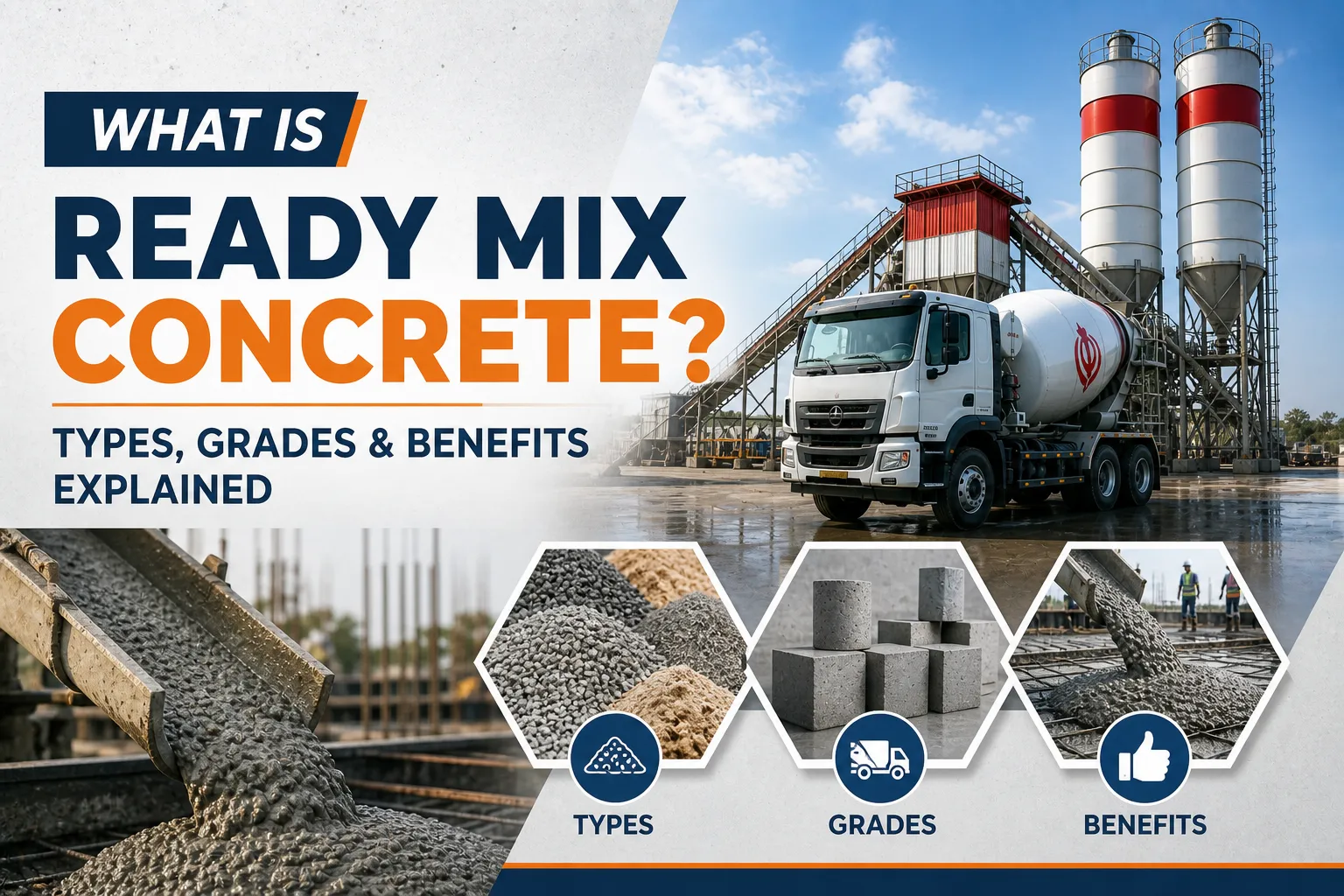
What is Ready Mix Concrete? Types, Grades & Benefits Explained
May 4, 2026
Introduction: Why Ready Mix Concrete Matters Today
If you’re planning a construction project—whether it’s a house, apartment, or commercial building—one decision can directly impact your project’s strength, cost, and timeline:
 What type of concrete should you use?
Traditionally, concrete was mixed manually at the construction site. But today, most modern projects are shifting to Ready Mix Concrete (RMC)—and for good reason.
In this guide, you’ll learn:
- What ready mix concrete is
- Its different types and grades
- Why it’s better than traditional site-mixed concrete
What is Ready Mix Concrete?
Ready Mix Concrete (RMC) is concrete that is manufactured in a batching plant using a precise mix of:
- Cement
- Water
- Aggregates (sand, gravel)
- Admixtures (for performance improvement)
It is then transported to the construction site using transit mixer trucks, ready for immediate use.
Unlike traditional mixing, RMC ensures:
- Consistent quality
- Accurate proportions
- Faster construction
How Ready Mix Concrete is Made
The process is highly controlled and technology-driven:
- Material Selection
High-quality cement, sand, aggregates, and chemicals are selected. - Batching Process
Materials are measured accurately using automated systems. - Mixing
Concrete is mixed uniformly in a batching plant. - Quality Testing
Tests like slump and strength checks ensure consistency. - Transportation
Delivered to site using transit mixers without losing quality.
Types of Ready Mix Concrete
Different projects require different types of concrete. Here are the most common:
1. Transit Mixed Concrete
- Mixed in the truck during transportation
- Most commonly used type
2. Shrink Mixed Concrete
- Partially mixed at plant, rest in transit
- Saves time and improves consistency
3. Central Mixed Concrete
- Fully mixed at the plant
- Offers highest quality control
Concrete Grades Explained (M20, M25, M30…)
Concrete grades define strength and load-bearing capacity.
Common Grades:
- M20→ Residential buildings
- M25→ Standard structural work
- M30→ Commercial projects
- M35 & M40+→ High-rise and heavy-load structures
The higher the grade, the stronger the concrete.
Benefits of Ready Mix Concrete
Here’s why most builders now prefer RMC:
1. Consistent Quality
Produced in controlled environments with strict quality checks.
2. Faster Construction
No on-site mixing → saves time and labor.
3. Cost Efficient
Reduces:
- Material wastage
- Labor cost
- Project delays
4. Better Strength & Durability
Accurate mix design ensures long-lasting structures.
5. On-Time Delivery
Modern batching plants use centralized dispatch systems for timely supply.
6. Eco-Friendly
Less dust, reduced waste, and efficient material usage.
Ready Mix Concrete vs Site Mix Concrete
| Feature | Ready Mix Concrete | Site Mix Concrete |
|---|---|---|
| Quality | High & consistent | Varies |
| Time | Fast | Slow |
| Labor | Low | High |
| Waste | Minimal | High |
| Strength | Reliable | Inconsistent |
RMC clearly offers better performance for modern construction.
Why Ready Mix Concrete is Popular in Chennai
With rapid urban development, Ready Mix Concrete in Chennai has become the preferred choice because:
- Faster project execution
- High-rise construction demand
- Skilled labor shortage
- Need for consistent quality
Builders and contractors now rely on trusted suppliers for reliable and timely delivery.
Is Ready Mix Concrete Right for You?
If your goal is:
- Strong and durable construction
- Faster project completion
- Reduced operational hassle
Then Ready Mix Concrete is the best choice.
Need Ready Mix Concrete in Chennai?
SVM Readymix provides:
- High-quality concrete (M20 to M40+)
- Advanced batching technology
- On-time delivery
- Reliable service for all project sizes
Contact us today to get a quote for your project.
No comments yet